# Dev Training ### Sensitive Data Exposure <!-- .slide: class="title-slide" --> ## Sensitive data ### What is it? * Any data that is meant to be protected against unauthorized access * In the EU certain types are covered by GDPR * Personally identifiable data (PII) * GDPR: Strict limits on how personal data * Is stored * Is gathered * Is transmitted Notes: * What is sensitive data? * Broad definition. * Depends on who you ask. * Personally Identifiable Info (PII) * Protected by regulations. * All kinds of user or system secrets. ### Examples * Personal data * Intellectual property * Credentials, passwords, API keys, etc Notes: * Other examples include IP, for example. ### How is it exposed * Exploits of other vulnerabilities * SQL/path/command injection * Security misconfiguration * Known vulnerabilities * Cryptographic failures Notes: * Can be exposed in many ways. * All kinds of exploits. * Cryptographic failures. * Usually misconfiguration. ## Information Disclosure ### Accidental exposure * Credentials in version control * Credentials in public container in Docker registry * Web framework debugging enabled Notes: * Human error can be the direct cause. * These examples. * Sometimes also social media posts, for example. ### Serving excessive amounts of data * User profile endpoint shows address, gender, shoe size and blood type * UI only shows the user's name * User profile picture has metadata showing location Notes: * Sometimes web apps provide TMI. * UI should not be used as filter. * We can peek behind the curtain. * Image metadata. * Used to dox people in the past. ## Protecting data ### Sensitive data Needs to be protected **in transit** and **at rest** Notes: * These are both important and very different concerns. ## In transit ### Secure protocols * At the network layer, data needs to be protected by using encrypted protocols * HTTPS * TLS 1.3 or higher * Test your servers with [Qualys SSL Labs](https://www.ssllabs.com/) Notes: * Securing data in transit. * Good protocols. * Encrypted. * Great resources available to test. ## At rest ### Encryption * Extensive and complicated topic * Crypto is **hard** * Not all crypto is created equal * A lot of insecure/broken algorithms exist out there * Small implementation mistakes can result in broken crypto Notes: * Encryption is hard, do not try. * Use ready-made solutions. * Do some research. * General security practices apply. ### Recommended algorithms * Use built-in pre-configured algorithms in frameworks or languages if they meet your requirements * Less room for error * Symmetric crypto * AES * Elliptical curve * Asymmetric * RSA * Elliptical curve * RTFM! Notes: * Consult the documentation, always! * Use popular, built-in stuff. * Get familiar with crypto basics. * Consult the documentation! * Hope I sound like broken record. ### AES * Don't use ECB mode * Most modes use *Initialization vectors* (IVs) * IVs should never be reused * IVs should not be predictable * IVs should be generated using **cryptographically secure** random number generators Notes: * AES is backbone of the internet. * Block cipher * Multiple modes of operation. * ECB is bad! * Follow specs for config/setup. ### Seriously, Don't use ECB 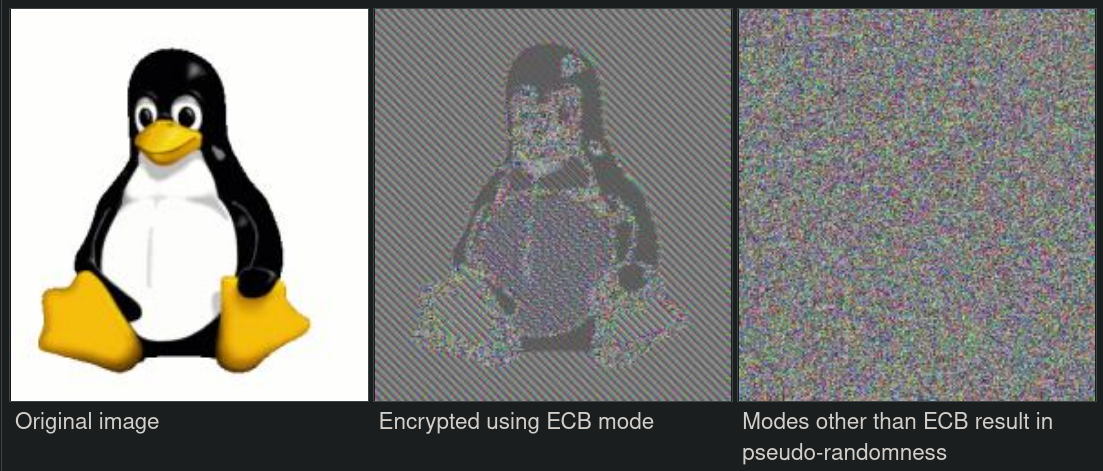 Notes: * This is how bad ECB is! ### Asymmetric * RSA * Use at least 2048 bits * Elliptical curve * Use known curves like *Curve25519* Notes: * RSA/elliptic curve algorithms are asymmetric. * Public/private keys. * More bits of key material = better. * Today, RSA with less than 2048 is bad. * Use tried and tested elliptic curves. * E.g. 25519. * Math is beyond me. ### Key management * Encryption is not a silver bullet * It does not secure data on its own * Encryption/secret keys need to be kept safe * E.g., storing encryption key in database render encryption pointless if DB is dumped Notes: * Encrypted does not automatically mean secure * Data only as safe as keys. * Store keys separately from data. ### Whatever you do # **Don't do your own crypto** <!-- .element: class="fragment" data-fragment-index="1" --> Notes: * If implementing access control from scratch is bad. * Implementing your own cipher is worse. * You will fail. Not trying to be mean. ### Secrets in Version control systems ### A common shortcut * Very common to see production secrets in VCS * VCS is not a secret storage! * Leaked source code should not entail a breach or compromise Notes: * Extremely common issue. * Assume your source code is common knowledge. * Do not store any secrets there, ever! * Assume prior breach. ### What should I do instead? * Inject secrets at build time * CI/CD (Although this makes the CI/CD systems a very juicy target) * Inject secrets at runtime * Store secrets in production environment (bare metal) * Store secrets in secret store Notes: * Use runtime injection * Most frameworks have good tools for this * Can be done in CI/CD. * May introduce other risks. * It depends. ## Passwords ### Protecting passwords * Should be considered very sensitive user data * Although GDPR does not agree * Complete database compromise should not entail a leak of passwords * Passwords should always be stored using a one-way cryptographic hash function * Never store passwords encrypted! * Developers should not be able to access them Notes: * Very sensitive data. * Do not store! * Use cryptographically secure hashing! * Encryption is actually bad! ### Cryptographic hash function * A one-way function $h$ * Used to verify integrity of messages * Collision should be very unlikely: $h(m_1) = h(m_2)$ where $m_1 \neq m_2$ * Given a hashed value, finding a different message that yields the same hash should be almost impossible Notes: * One way functions. * Used for quick data comparison. * Verify data integrity. * Validate passwords. * Collision should be practically impossible. ### Password storage * Some cryptographic hash functions are fast * Unsuitable for storing passwords * Makes brute-forcing easier * Hash functions are predictable * Possible to precalculate (rainbow table) Notes: * There are many considerations. * Avoid implementing this yourselves. * Use popular, built-in tools! * Endless pitfalls exist. * Which compromise security. ### Password hashing * Subcategory of cryptographic hashing * Usually involves multiple rounds or some other mechanisms to slow the process down * Algorithms need to be carefully selected * MD2/4/5 are unacceptable * SHA-1 being phased out Notes: * Password hashing is its own science. * Often multiple rounds of salted hashing. * Algorithm matters! ### Salt * Random string added to the password before hashing * Should be at least 32 bits * Follow recommendations for hash function * Stored along with the hashed password * Prevents rainbow table attacks * Built into some password hash functions ### Pepper (secret salt) * Static (secret) string that is added to the password before hashing * Cannot be changed * Not stored with the hashed password * Protects against brute-force attacks in case of leak ### Algorithms * *bcrypt* – Based on blowfish * *scrypt* – High memory use * *PBKDF2* – Generic algorithm * *Balloon* - High memory use ## Rules of thumb ### General * Collect as little sensitive data as possible * Can't leak what we don't store * Serve as little data as possible * Expose as little data as possible ### In transit * Use encrypted protocols ### At rest * Encrypt sensitive data * Keep encryption keys safe * Use secrets (or key) management systems ### Password * Choose a good hash function * Salt and pepper ## Epilogue ### Further reading * [NIST - Cryptographic Standards and Guidelines](https://csrc.nist.gov/projects/cryptographic-standards-and-guidelines) * [OWASP - Protect Data Everywhere](https://owasp.org/www-project-proactive-controls/v3/en/c8-protect-data-everywhere#) * [OWASP - Cryptograhic Storage](https://cheatsheetseries.owasp.org/cheatsheets/Cryptographic_Storage_Cheat_Sheet.html) * [NIST - Authentication and Lifecycle Management](https://nvlpubs.nist.gov/nistpubs/SpecialPublications/NIST.SP.800-63b.pdf) ### Hall of fame * [British Airways hit with €22m fine for being phished](https://edition.cnn.com/2019/07/08/tech/british-airways-gdpr-fine/index.html) * [Marriott hit with £20.4m fine for being hacked](https://www.theguardian.com/business/2019/jul/09/marriott-fined-over-gdpr-breach-ico) * [InfoMentor fined 3.000.000 isk for breach](https://www.personuvernd.is/personuvernd/frettir/personuvernd-sektar-infomentor-ehf.-vegna-oryggisbrests#) * [Icelandic minister shows her driver's license](https://twitter.com/aslaugarna/status/1222561959834419200) * [Australian PM posts picture of plane ticket](https://mango.pdf.zone/finding-former-australian-prime-minister-tony-abbotts-passport-number-on-instagram) * [Facebook friends are not always "friends"](https://www.reddit.com/r/Whatcouldgowrong/comments/ly6j7c/wcgw_with_sharing_your_achievements_on_the/)